

![[Translate to English:]](/fileadmin/_processed_/2/0/csm_Header_Ecksberg_1210x680_157c4e165d.jpg "[Translate to English:]")
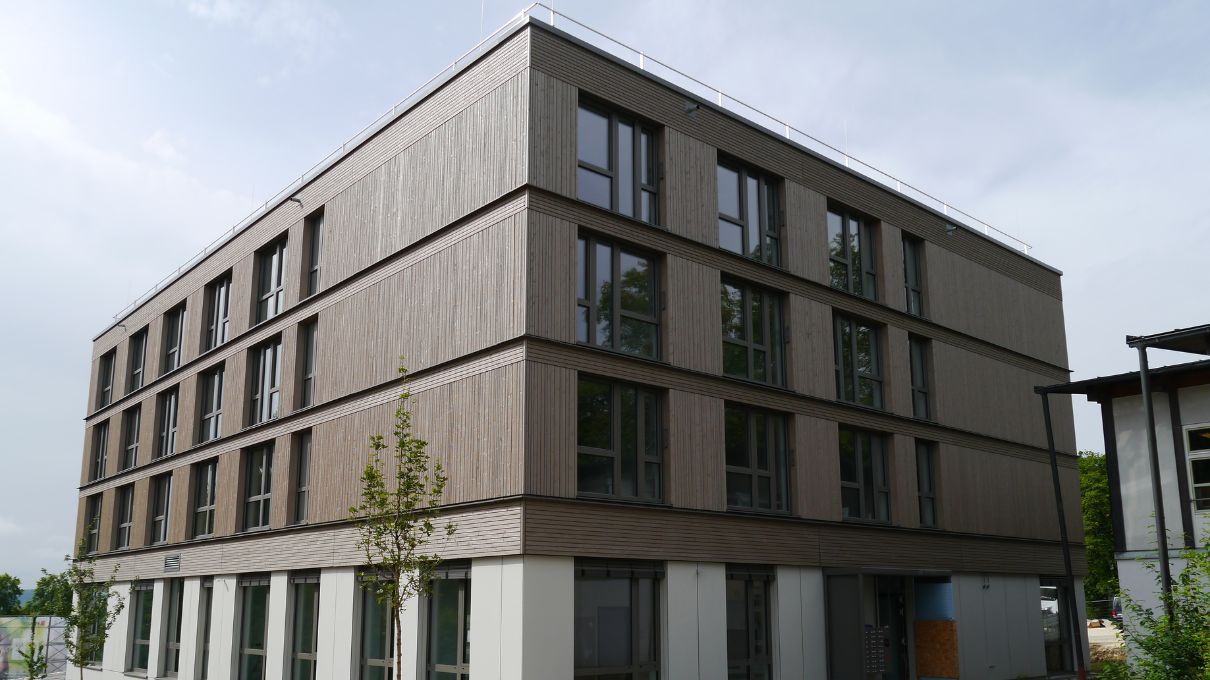
Heidenheim clinic implements decentralised comfort ventilation concept with prefabrication
Patient well-being is especially important in the health sector. A positive environment and pleasant atmosphere in the room can greatly enhance the recovery process. So, when building the new dialysis centre and connected apartment block, the Heidenheim clinic incorporated a decentralised ventilation concept into the individual residential units. The comfort ventilation units with heat recovery used were supplied by Meltem, the ventilation specialist based in Alling near Munich. It was possible to incorporate significant components of the ventilation units into the prefabricated external wall modules, making installation on site especially simple.
Large-scale construction project
A lot is happening on the castle hill in Heidenheim. There have been a number of construction projects associated with the clinic in recent years, all aimed at upgrading what is an important health location for the region. Further development of the construction plan resulted in creation of the Schlosspark – a new residential district close to the forest and right in the vicinity of Schloss Hellenstein. It connects directly to the area around the clinic. Much of the space for the new housing development was opened up by demolishing the old nurses’ hostel, which had not been used for a few years. The development is also intended to extend as far as Schlosshaustraße, which encloses the castle hill. The new dialysis centre with the apartment block was built right at the entrance to the clinic site.
Pioneering hybrid construction
The main contractor, Essinger Wohnbau GmbH, opted to implement the project as a hybrid construction. Thus the basement and ground floor, along with the stairwell, internal walls and pilings, were built as solid constructions. The bathrooms and wet rooms were incorporated into the individual residential units as prefabricated modules during the shell construction phase. The facade for the individual storeys is timber-clad.
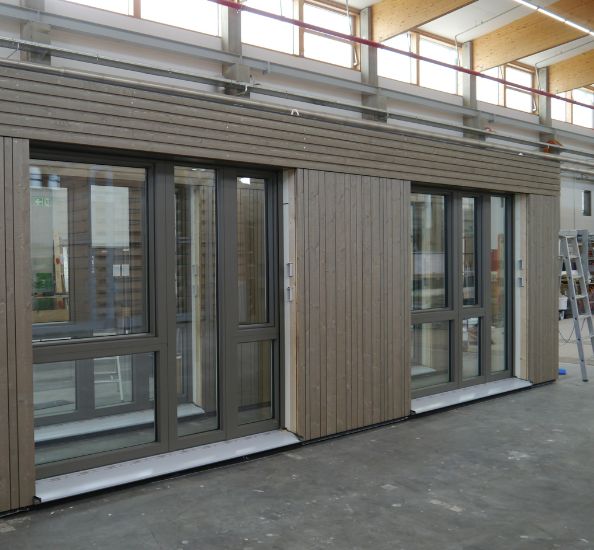
It consists of individual, prefabricated facade elements which were brought to the site on trucks and finally installed on the building on site. This way of working has a range of benefits. For a start, the extent of prefabrication greatly reduces the overall construction time. The windows, wall boxes and ventilation ducts for the comfort ventilation units and the ductwork for the electrical installation work were already pre-fitted at the factory. This construction method also allows high energy standards to be met. The dialysis building was thus constructed in accordance with the German Building Energy Act (GEG) and with reference to the KfW 40+ standard, while the connected residential block was built as a KfW 40+ efficiency structure.
A roughly 210 m² photovoltaic system was installed on the flat roof, which also offered space for an air conditioning unit. The two buildings are heated via an air-to-air heat pump. The clinic is also connected to the district heating system to cover peak loads.
Controlled home ventilation reduces heat input
With one eye on power consumption, the dialysis centre and connected apartment building were designed to the KfW 40+ efficiency standard. This prescribes an annual primary energy requirement of up to 40 kW/h per square metre of floor space per year. To achieve this, the architect planned the installation of a comfort ventilation system with heat recovery for the individual residential units. Since ventilation was required in both the living / sleeping area and the bathroom of each residential unit, the M-WRG-II E-T-F decentralised system with humidity sensors was used.
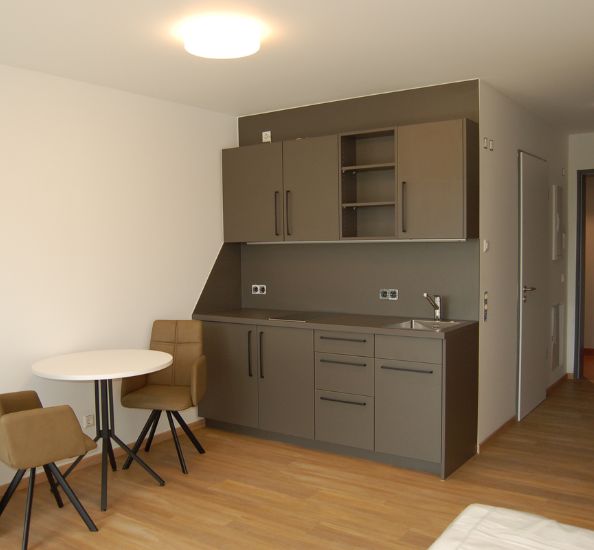
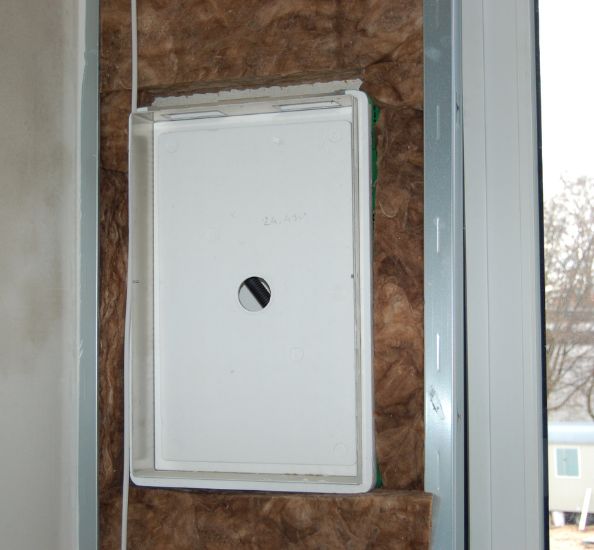
These units are located immediately beside the window and the ventilation ducts for the fresh air intake and exhaust air removal, which are fitted at the prefabrication stage, open into the reveal of this window. The units are operated via the hard-wired InControl pushbutton sensor. They can be regulated separately and individually in each residential unit.
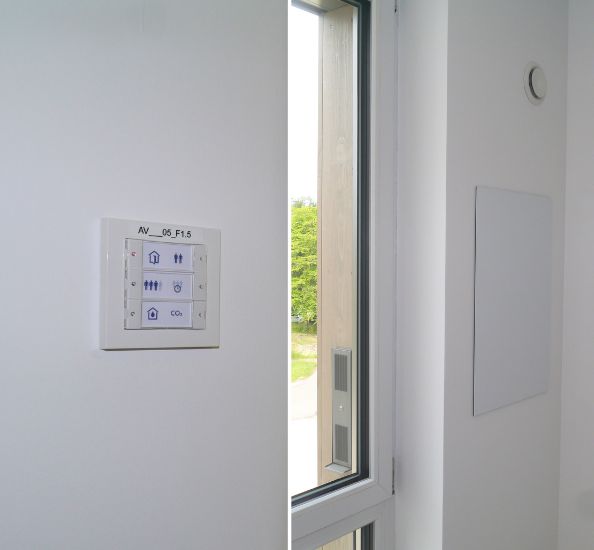
The bathrooms without outside windows were connected to the extract air area of the M-WRG-II unit using flexible pipes on the filigree slab for venting as per DIN 18017-3. The used air is extracted via a poppet valve in the bathroom ceiling.
“Invisible” reveal solution
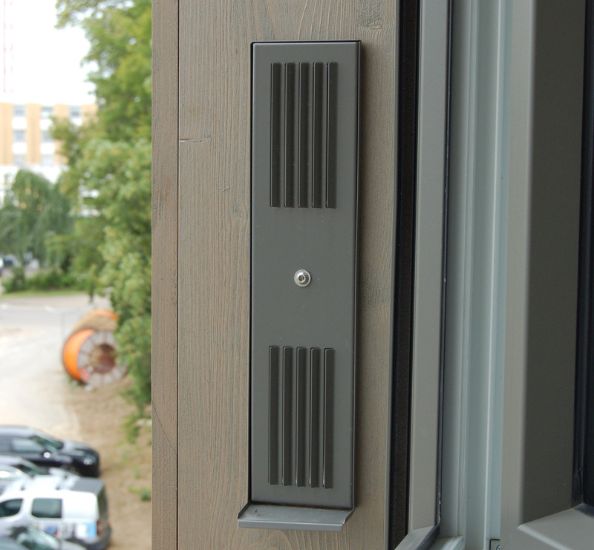
Decentralised ventilation units are almost always installed in the external walls, which means that the air outlets are generally attached to the facade. However, Essinger Wohnbau GmbH was looking for a more discreet solution for the Heidenheim project. “Ventilation outlets often look untidy and interrupt the structure of the facade. So we looked for a solution that is integrated into the window reveals so as not to impair the visual appearance of the facade, said Lars Fischer of Essinger Wohnbau GmbH.
The solution was finally sourced from Meltem, the ventilation specialist based in Alling near Munich. This enabled a package to be put together that is specially tailored to the conditions on the building. The system is based on the M-WRG-II ventilation unit with heat recovery which is available as standard from Meltem.
The ventilation unit’s outdoor and exhaust air pipes normally terminate at the building facade and are protected against wind and weather by the outer wall terminal. By using an extended air duct system with flat ductwork in the external wall, the openings of the outdoor and exhaust air pipes open directly into the window reveal in the Heidenheim construction project. They are thus practically invisible to a person standing in front of the building. The external termination takes the form of an unobtrusive stainless steel faceplate. This was supplied in the appropriate RAL colour on request.
Ventilation concept with many benefits
Installing a comfort ventilation system will not only save on heating costs, but will improve the living environment and thus the well-being of the residents. A continuous supply of fresh air is guaranteed. In contrast to conventional window ventilation, there are no unwanted drafts with a ventilation system. The room temperature remains almost constant since the fresh air is preheated before it is introduced. Mould spores, mites and other pollutants in the ambient air, such as off-gasses from furniture and carpets and an excessively high CO2 concentration are removed together with the used air and transported outside. This benefits all the residents, especially those with pollen allergies. The M-WRG-II ventilation units are equipped as standard with a fine particulate filter (“allergy filter”). An activated charcoal filter is also available; this binds most odours and harmful gases from fuels and removes nitrogen oxides and ozone from the air.
Summary
The Heidenheim dialysis centre shows that contemporary ventilation systems can be combined even with sophisticated architecture. This means that energy savings, a healthy living environment and good design are not mutually exclusive. Using the special window reveal solution for the ventilation units worked so well for Essinger Wohnbau GmbH that the company intends to use it in future for other, similar construction projects. The residents and operators will in any event benefit from the excellent internal room air quality and lower energy costs.
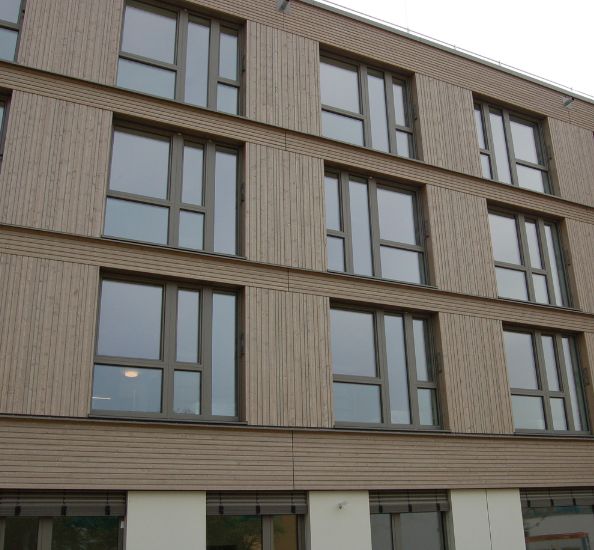
Given the high degree of prefabrication, a ventilation unit could be very quickly installed in the prepared installation kit within the facade module in each apartment.